Additive Manufacturing & 3D Printing News Roundup (Dec. 20, 2025–Jan. 5, 2026)
Posted in :

Industry News
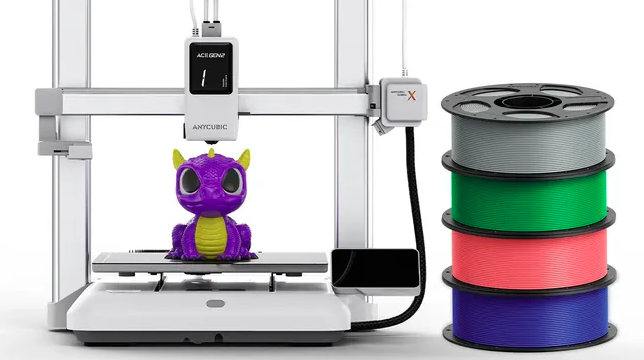
Anycubic promises its Kobra X high-speed multi-filament printer can print over twice as fast and with half the material for $259 — Anycubic announced the Kobra X, positioning it as a low-cost (early-bird $259) multi-filament system with a purge-reduction design meant to cut waste and speed up multi-material jobs. The company claims a shorter cutter-to-nozzle path and reduced retraction distance can materially reduce “poop” time—one of the biggest pain points in hobbyist multicolor printing. If real-world results match the claims, this pushes the mass market further toward “multi-material by default,” raising expectations for waste control, reliability, and total cost-per-print.
Velo3D Secures Department of War Contract Valued at $32.6M to Eliminate Critical Defense Manufacturing Bottleneck — Velo3D disclosed a $32.6M OTA contract supporting DIU’s Project FORGE to prototype and qualify additively manufactured components for a “major weapon system program of record.” The release emphasizes scaling production (not just prototyping), including an option to explore large-format LPBF capability and rapid qualification workflows. The significance is the continuing shift from “AM as a specialty” toward AM as surge-capacity infrastructure—where qualification speed, cybersecurity posture, and fleet repeatability matter as much as part performance.
Metal Powder Works enters powder partnership with Austal USA — Metal Powder Works (MPW) and Austal USA announced a powder partnership to co-develop additional powder specifications tailored to Austal’s AM programs, including work tied to the U.S. Navy’s Additive Manufacturing Center of Excellence. Beyond the headline partnership, the notable piece is the explicit path toward a commercial offtake agreement (minimum volumes, pricing, lead times) if development succeeds—i.e., moving AM powder supply from opportunistic purchasing to programmatic procurement. For maritime/defense AM, that’s a concrete signal that supply chain and powder spec control are becoming strategic levers, not back-office details.
Sinto Advanced Ceramics officially becomes new name for Bosch Advanced Ceramics — The Bosch Advanced Ceramics business completed its naming transition to “Sinto Advanced Ceramics,” reflecting the integration into Sinto’s portfolio and go-to-market. For customers, this kind of transition often determines whether ceramic AM remains an “R&D adjacency” or becomes a stable industrial offering with clearer service, applications support, and investment priorities. It’s also a reminder that consolidation and branding changes in niche AM segments can materially affect qualification continuity, preferred supplier lists, and long-term material/process roadmaps.
New Products & Technologies
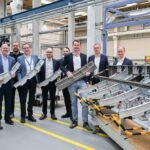
Airtech pushes boundaries of LFAM with 3,000 lb T-100GF structure — Airtech highlighted a large-format composite print: a ~3,000 lb thermoplastic structure using its glass-fiber-reinforced T-100GF. While LFAM is no longer “new,” the continued scale-up in printed mass and reinforced thermoplastics points to a steady march toward bigger tools, molds, and end-use structures where machining/layup lead times are the bottleneck. The practical takeaway is that materials like GF-filled thermoplastics are increasingly the decisive variable—balancing deposition stability, stiffness, and downstream finishing.
Shimizu Corporation develops spray-based 3D concrete printing — Shimizu reported a spray-based approach to concrete printing aimed at expanding geometry freedom beyond conventional gantry/extrusion constraints. Spray-based deposition is attractive because it potentially reduces unsupported overhang limitations and may better conform to irregular substrates or repair scenarios. The main question for market impact is process control: achieving consistent layer properties, bonding, and structural certification while managing rebound/waste that spray methods can introduce.
In situ 3D printing advances thermoset fabrication — Researchers at Xiamen University demonstrated a laser-assisted direct ink writing method that solidifies thermosets in situ, enabling free-standing structures without support material. Reported capabilities include sub-second curing, ~50 µm resolution, and wide tunability of mechanical/electrical properties via process control. If this scales, it strengthens a key theme: thermosets (long tricky to print cleanly) are becoming more programmable, which matters for microfluidics, soft robotics, and multifunctional devices where thermoset performance is valuable but manufacturing options have been limited.
Regulatory & Standards Updates
Advanced Manufacturing Technologies Designation Program — FDA posted updated content (current as of 12/30/2025) for its final guidance on the Advanced Manufacturing Technologies (AMT) Designation Program, which is aimed at encouraging earlier adoption of advanced manufacturing approaches in pharma. While this is not “3D printing-specific,” it is part of the broader regulatory normalization of advanced manufacturing, which can influence validation expectations for AM-enabled drug products and device-adjacent manufacturing ecosystems. For AM suppliers serving life sciences, it reinforces that regulatory-facing documentation and early engagement pathways are becoming more formalized—not optional.
Q4 Engines & Propellers Issues List 12/30/2025 — The FAA’s Q4 issues list explicitly flags “Propulsion Structures Additive Manufacturing” as a topic likely to require an issue paper to establish means of compliance when proposing AM engine parts, and it points to existing guidance (e.g., for PBF). The significance is less about new rules and more about where certification friction is expected: applicants should plan early alignment on process controls, material allowables, inspection/monitoring, and substantiation strategy. In practice, this tends to push AM programs toward tighter, auditable digital thread practices and earlier regulator engagement.
Research & Academic Insights
Virginia Tech advances additive friction stir deposition — Virginia Tech highlighted progress in additive friction stir deposition (a solid-state process) that can be attractive for high-deposition-rate metal builds with different defect profiles than fusion processes. Solid-state approaches can reduce issues like solidification cracking and may simplify certain qualification pathways, especially for repair or large structures. The key industry angle is optionality: as more organizations seek “right process for the part,” AFSD and other solid-state techniques expand the viable design/manufacturing space beyond PBF/DED.
Rutgers engineers use AI to overcome AM challenges — Rutgers researchers reported AI-driven approaches aimed at improving AM outcomes, reflecting the ongoing trend of applying ML to process monitoring, defect prediction, and parameter optimization. The near-term value is practical: better yields and less trial-and-error, particularly when materials or geometries push stability limits. The medium-term implication is competitive differentiation—shops that can close the loop between sensing, prediction, and control will tend to win on cost, repeatability, and qualification speed.
Duke University launches $3.2 million effort to 3D print a living lung — Duke (with collaborators) received a four-year, $3.2M NIH grant to use bioprinted lung models to study virus–bacteria interactions using ventilated, tissue-like structures. This is a clear example of bioprinting’s “model-first” path to impact: improving disease research and therapy development without immediately claiming implantable organs. For the AM ecosystem, it continues to build demand for reproducible bioinks, controlled tissue fabrication, and standardized test methods—areas where tooling, materials, and QA are still immature.
Sector Applications
Aerospace: Velo3D Secures Department of War Contract Valued at $32.6M to Eliminate Critical Defense Manufacturing Bottleneck — The story is about qualification and throughput at scale, not just printing: defense programs are funding AM specifically to remove production bottlenecks and expand industrial capacity.
Medical/Dental: US Air Force enhances Airman readiness with digital dentistry — The Air Force described using in-house scanning and 3D printing to reduce chair time and keep more procedures in-house, tying AM directly to readiness and continuity of care in a mission-driven healthcare environment.
Construction/Defense/Consumer: Plans for 3D printed church in Czechia progress — High-visibility construction projects continue to serve as “proof to the public,” but the deeper value is in permitting, material acceptance, and repeatable onsite workflows that can generalize to other civic/infrastructure applications.
Construction/Automotive/Defense/Energy/Consumer: Shimizu Corporation develops spray-based 3D concrete printing — If spray-based concrete printing proves controllable and certifiable, it could open new use cases (repair, complex surfaces, constrained sites) where extrusion gantries struggle.
Social Chatter: Across Reddit and forums, the dominant hobby conversation continues to be multi-material printing tradeoffs: purge waste, reliability of feeders/AMS-style systems, and how much “automation” is worth paying for. Threads also show renewed attention to safety/quality incidents (e.g., component issues and recall-adjacent discussions) and what manufacturers are doing to address them. On YouTube, quick-turn reviews of new low-cost multi-filament platforms and “is it actually faster/less wasteful?” stress tests are drawing the most engagement, alongside broader debates about open vs. closed ecosystems and firmware update cadence.